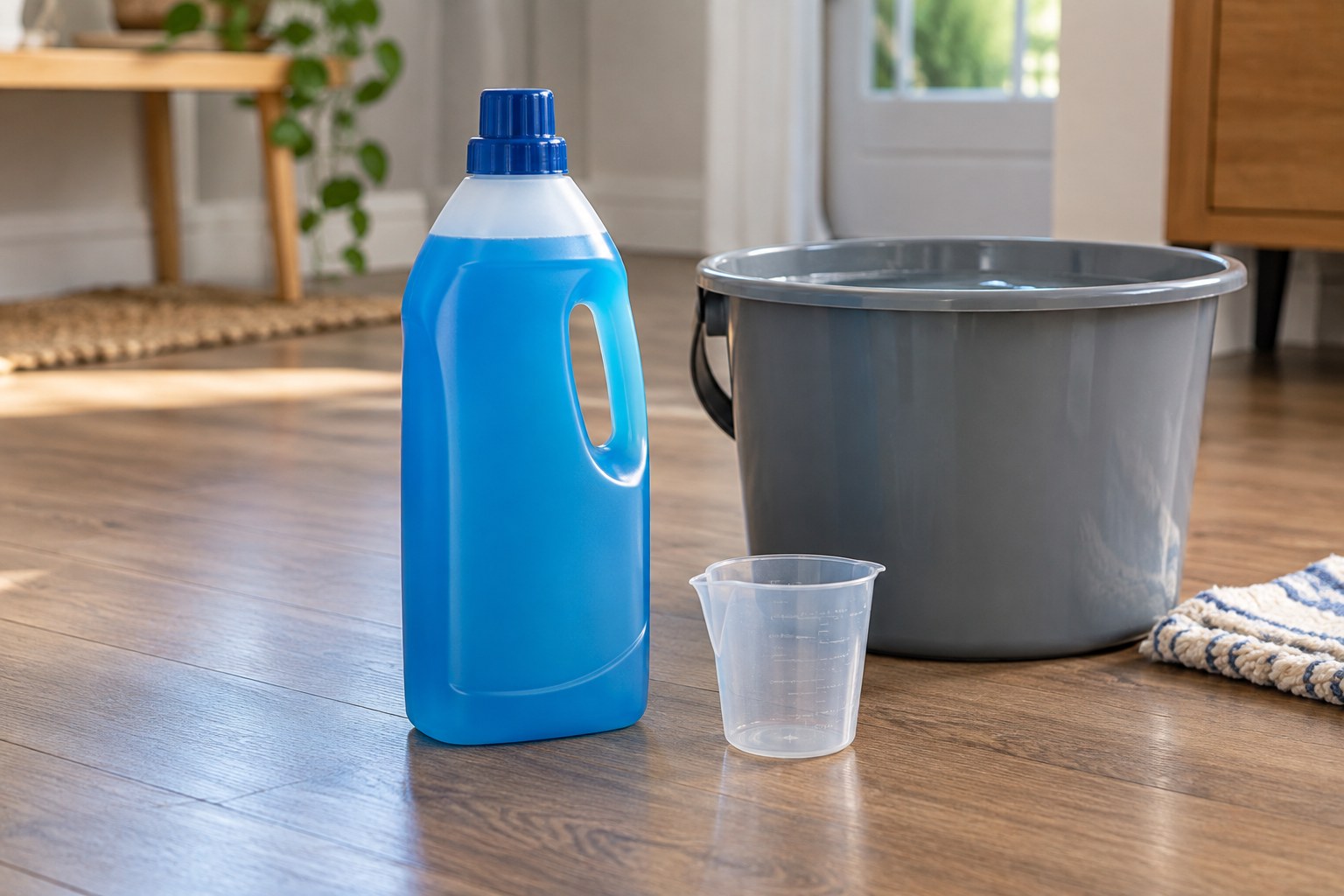
Two cleaners can have very different litre prices because one is ready to use and the other concentrated. Comparing bottle prices alone then says little about the cost of the intended application. You need the exact instructions and a shared task for which both products are suitable.
Do not begin with a dilution of your own choosing. Read the quantity specified for the application and whether the product is intended to be diluted at all. Instructions for another surface or level of soiling should not quietly enter the calculation.
Read the unit precisely
Some directions specify millilitres per litre of water; others give an amount for a particular container or an explicitly defined mixture. Those descriptions are not automatically equivalent. If a ratio is unclear, ask the manufacturer rather than inventing an interpretation for the price comparison.
Use an appropriate measuring aid and keep the units consistent. A cap is a defined quantity only when the product information makes it one. An arbitrary household spoon does not replace an exact dosing instruction.
Consider a purely mathematical example: a bottle contains 500 millilitres, and a fully specified application uses 10 millilitres of product. That gives 50 applications. At an assumed bottle price of $5, the product cost would be ten cents per application. These invented figures are not mixing instructions for a real cleaner.
Compare equivalent tasks
An “application” can mean very different things. Cleaning a small object and cleaning an entire floor are not equivalent units. A useful cost comparison should connect the area, intended use and required quantity clearly.
Include necessary tools. If a particular dosing attachment or suitable container is required, it belongs in the initial purchase. Recurring replacement parts can be recorded separately. Suitable accessories already owned do not need buying again simply because they appear in a set.
Handling is part of the choice
A concentrate may fit the routine poorly if the required dose is repeatedly measured inaccurately or there is no appropriate place to prepare it. Read the complete protection, storage and use instructions. Do not combine different cleaning products.
Do not prepare more diluted product than the label permits for the intended routine. Storage and usable periods for prepared mixtures are product-specific. A large container of premixed solution is not automatically a useful simplification.
For replenishment, a short note of the product variant, intended task and manufacturer's dose can help. Read the packaging again when a formula changes. The previous calculation remains meaningful only if the relevant instructions are unchanged. This turns an eye-catching litre price into a comparison connected to actual use.