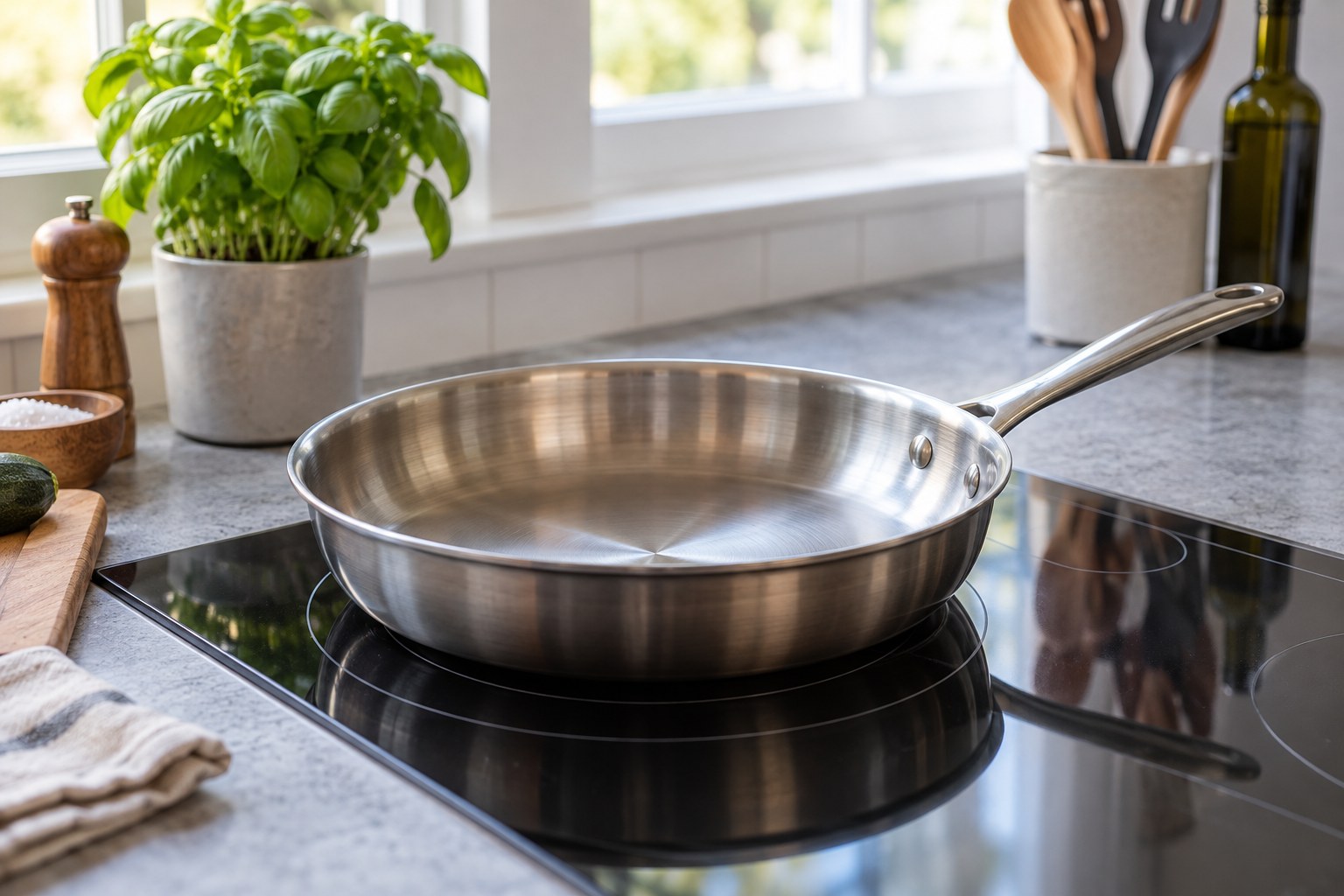
The size printed on a frying-pan package often describes its upper diameter. Matching a pan to an induction zone also requires attention to the working base. A broad opening above a much smaller base can therefore be misleading in a comparison.
Check the base, not just the rim
Find the induction-suitability statement and base dimensions. Compare them with your hob's requirements. Its instructions may specify permitted sizes and conditions for pan detection. A magnetic impression alone does not replace that check. Bosch's cookware guidance likewise discusses the need for appropriate cookware on induction appliances.
Inspect the underside in photographs or in person. The pan should suit the intended use without experiments involving extra adapter plates. If the information is unclear, an enquiry giving the exact hob and pan identifiers is more useful than buying speculatively. Keep the compatibility decision separate from attractive styling or a promotional price.
Consider the usable cooking area
Think about the amount you normally cook in one layer. Sloping sides can combine a wide opening with a much smaller flat surface. Measure an existing pan that works well and use it as a reference. This avoids assuming that a familiar nominal diameter provides the same useful area in every design.
The handle needs room too. Imagine two neighbouring zones in use and check whether pans and handles interfere. A larger pan offers little benefit if it repeatedly blocks access to another pot. Weight and handling should also make sense when the pan contains the food you plan to prepare.
Include care requirements
Read the instructions for the material and any coating. Not every pan permits the same utensils, cleaning products or temperatures. Choose a construction whose care you are willing to follow. An expensive material is not an advantage if it will regularly be treated contrary to its instructions.
Start with the size needed for your most frequent meal rather than a complete set of similar pans. A matching lid may be useful, but it must suit the diameter and intended use. The decision is well founded when hob, base, usable area and handling work together. A discount on a large diameter should matter only after those questions are resolved.