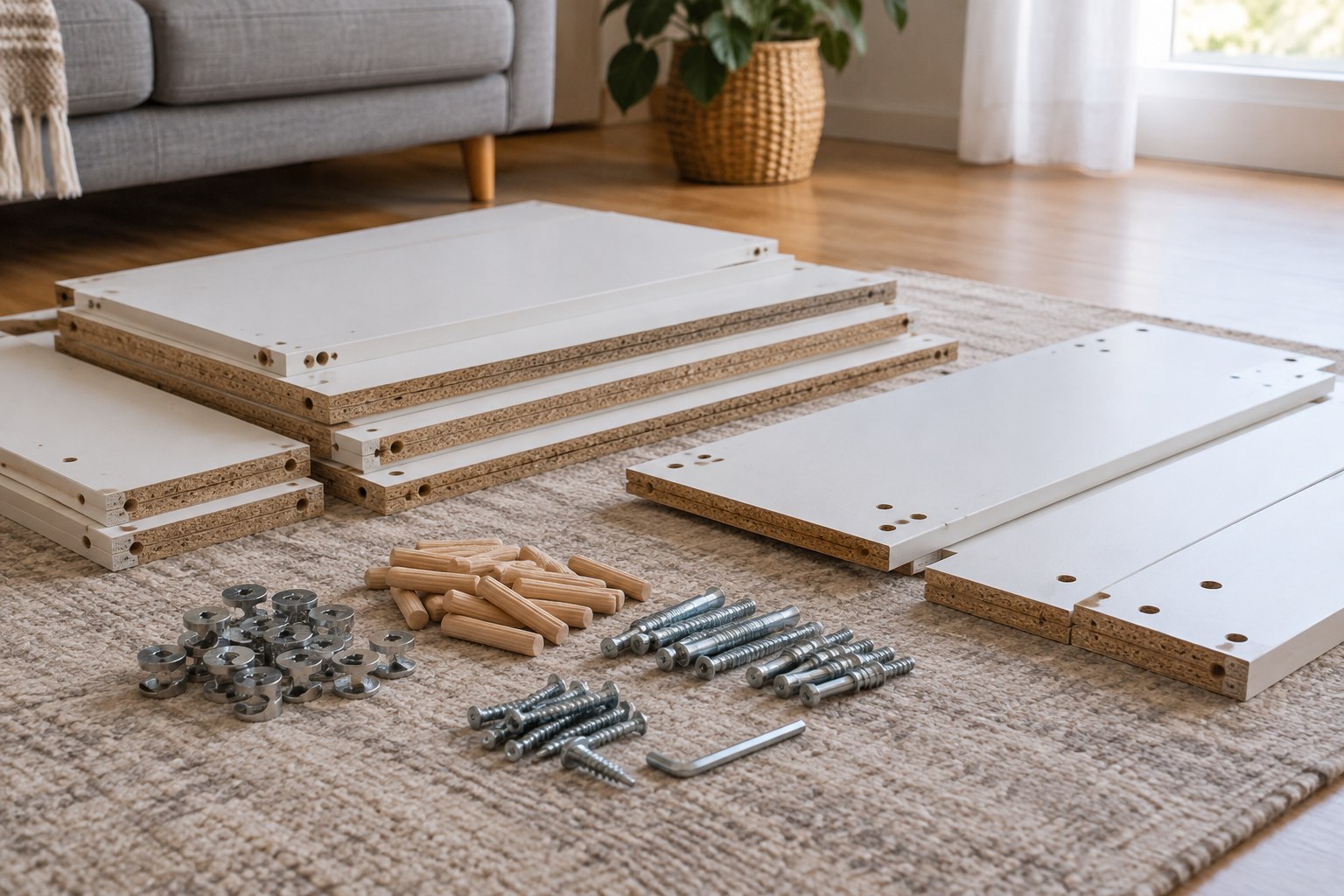
Flat pack furniture is often selected by outside dimensions, colour and price. Connections and fittings matter just as much during assembly and use. A missing screw, an unclear hinge specification or a fitting unavailable separately can turn a manageable assembly into a prolonged interruption.
Begin with the instructions for the exact model where they are available before purchase. They often identify components as well as showing steps. Read them as purchasing information: which tools, people and fixings are actually needed?
Establish the complete supply
Check whether doors, drawers, shelves and feet are included in the displayed price. A modular product photograph may show a combination whose parts must be ordered separately. A component list prevents comparing an inexpensive basic cabinet with a fully equipped unit.
Distinguish furniture fittings from any required fixing to the building. Wall material and location can require additional appropriate hardware. A bag of screws in the box does not automatically establish how the whole item should be secured in its intended position. Follow the specific instructions and obtain suitable advice for unresolved points.
Identify spare parts precisely
Ask how a missing or damaged fitting is identified. Is there a part number in the instructions? Can the seller provide that component or only a complete set? A general claim about spare parts is less useful than a clear link to the model.
Check currently offered prices and conditions where a frequently moving part may eventually need replacing. Availability today is not an indefinite promise. It still provides more information than assuming that similar-looking hinges or runners are interchangeable.
A used kit or previously opened package particularly needs a complete parts check. A missing structural fitting should not be replaced with something approximately suitable. The furniture needs to be capable of assembly in its intended configuration.
Include the real assembly effort
Read whether several people are required and how much working space is needed. A large item can occupy more room during assembly than when completed. Turning or raising it also needs to be possible under the specified conditions.
If assembly assistance is required, include it in the comparison. A low goods price plus professional assembly may still be appropriate; it simply produces a different total. Compare that complete arrangement with an offer that already includes assembly.
The instructions may also reveal issues for a future move. Being supplied flat initially does not establish that furniture can be dismantled indefinitely. Ask about the intended options if moving is relevant. Unapproved alterations or repeatedly opening unsuitable connections are not built-in features.
Check the delivery in order
Inspect the received packages and components before starting assembly, following the supplier's guidance. Keep model and order details available if something is missing or damaged. Losing track of parts after many assembly steps makes resolution unnecessarily difficult.
Retain the instructions and relevant part numbers with the purchase records. Any intentionally supplied spare fittings should be clearly labelled. A box of unidentified screws does not provide dependable replacement support later.
Compare two offers with the same component list
Create a shared comparison list for two suitable models: cabinet body, required shelves, doors, handles, feet and necessary assembly service. Include only components belonging to the respective construction and needed for your use. One model may include several, while another reaches the same function through additional line items.
Mark missing information as unresolved. An absent description of a back panel or fitting should not be entered as a zero cost. Clarification establishes whether it is included, sold separately or not part of that system at all. These open fields call for a question rather than a deceptively lower total.
Also compare how a failed component would be identified later. A clear part number in an available manual can make contacting the supplier easier. It guarantees neither a free replacement nor indefinite supply, but makes the intended process understandable. Treat this as useful organisation rather than a promised future saving. Keeping the original configuration beside that number also reduces the chance of requesting a part from a similar-looking but different version.
The final decision should establish what is supplied, how it can be assembled and how compatible parts are identified. Those details make an attractive price assessable. They do not replace appealing design, but prevent appearance from obscuring the purchase's practical requirements.